Whole-Child Care: Integrating Spiritual Practices Into Your Family's Health and Wellness Journey
When a child faces a serious illness, a mental health crisis, or a prolonged period of stress, parents instinctively reach for every available resource — medical specialists, therapists, school counselors, and community support networks. For many families across Westchester County, one of the most powerful resources available is also one of the least likely to appear on a care plan: faith.
At Children of Our Savior Westchester, our mission has always been rooted in the conviction that children flourish when they are cared for as whole persons. Physical health, emotional well-being, and spiritual vitality are not competing priorities — they are deeply interconnected dimensions of a child's life. Our work draws on a rich tradition of faith-rooted service, and we have witnessed firsthand how spiritual practices and religious community can serve as genuine sources of healing, resilience, and hope for families navigating difficult circumstances.
This is not a call to replace evidence-based medical or mental health care. It is an invitation to consider how spiritual wellness, thoughtfully integrated, can complement and deepen the care your child receives.
What the Research Actually Says
The relationship between spirituality and health outcomes has been a growing area of inquiry within academic medicine and pediatric psychology. Studies published in leading journals have found that children and adolescents who report a meaningful sense of spiritual or religious identity tend to demonstrate lower rates of depression and anxiety, greater capacity for stress regulation, and stronger recovery outcomes following serious illness or trauma.
Researchers at institutions including Harvard's T.H. Chan School of Public Health have documented associations between childhood religious participation and improved mental health outcomes in adulthood — including lower rates of substance use, higher reported life satisfaction, and greater social connectedness. These are not trivial findings. They suggest that the spiritual dimension of a child's life deserves attention not only from families and faith communities, but from pediatricians and mental health professionals as well.
Importantly, the benefits appear to extend across faith traditions. Whether a family's practice is rooted in Christianity, Judaism, Islam, Hinduism, Buddhism, or another tradition, the common threads — communal belonging, ritual, a sense of meaning, and connection to something larger than oneself — appear to be the active ingredients.
Prayer and Mindful Reflection as Daily Practice
For many families, prayer is already a natural part of daily life. What may be less obvious is how intentionally framing prayer as a health-supporting practice — rather than simply a religious obligation — can deepen its benefit for children.
Research on prayer and contemplative practice suggests that the physiological effects overlap meaningfully with those of mindfulness meditation: reduced cortisol levels, slower heart rate, and activation of the parasympathetic nervous system. For children who struggle with anxiety, nighttime prayer or a brief period of guided reflection before bed can serve as a calming anchor that signals the transition from the stimulation of the day to rest.
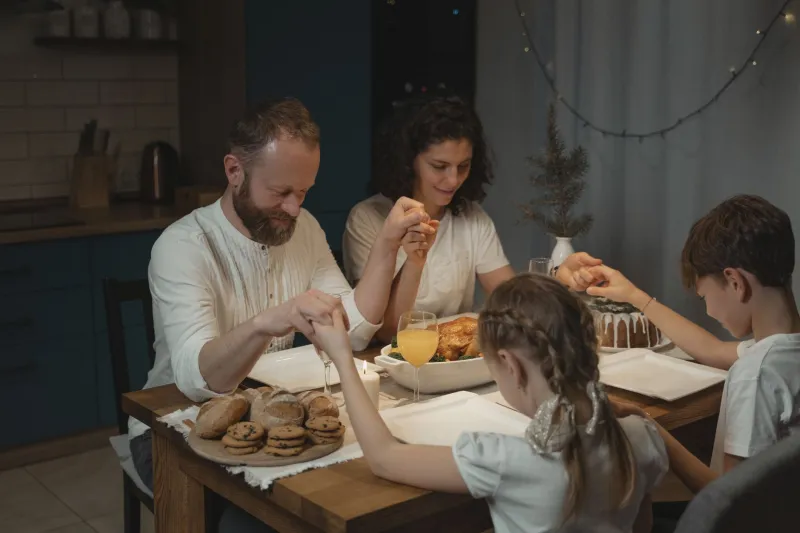
Families are encouraged to make prayer age-appropriate and participatory. Young children benefit from simple, concrete prayers that name specific people they love and specific things they are grateful for. Older children and adolescents may engage more deeply with reflective practices — journaling, contemplative reading, or meditative silence — that align with their maturing capacity for abstract thought. The goal is not performance but genuine engagement.
Religious Community as a Health Resource
One of the most consistently documented contributors to children's resilience is the presence of caring, non-parental adults in their lives. Religious communities are among the most reliable sources of such relationships. A child who is known and valued by a pastor, a rabbi, an imam, or a trusted Sunday school teacher has access to a form of social support that is qualitatively different from peer relationships or even family bonds.
For Westchester families navigating a child's health crisis, faith communities can provide practical support that meaningfully reduces family stress: meal trains, transportation assistance, childcare for siblings during medical appointments, and the simple but profound comfort of being held in prayer by a community that knows your child by name.
Families who are not currently active in a faith community but are interested in exploring one need not feel that the door is closed. Many congregations across Westchester welcome families at any stage of their spiritual journey and offer youth programs, family support ministries, and pastoral counseling as accessible entry points.
Ritual, Meaning-Making, and the Sick Child
When a child is facing a serious or chronic health condition, one of the most difficult dimensions of the experience is the loss of normalcy and the struggle to make sense of suffering. This is where religious ritual and the meaning-making frameworks offered by faith traditions can be especially powerful.
Ritual provides structure and predictability in circumstances that feel chaotic and uncontrollable. Lighting candles on the Sabbath, saying grace before meals, observing Ramadan as a family, or marking the liturgical seasons of the Christian calendar all create moments of sacred continuity that remind children — and their parents — that life holds more than the present difficulty.
Faith traditions also offer children language for suffering that secular culture often struggles to provide. The psalms of lament, the concept of perseverance in Islamic tradition, the Jewish practice of sitting shiva — these are not merely cultural customs. They are time-tested frameworks for processing grief, loss, and uncertainty in community rather than in isolation.
Pediatric chaplains, available at many hospitals serving Westchester families, are trained to provide this kind of spiritual support across faith traditions. If your child is hospitalized or receiving intensive outpatient care, requesting a chaplain visit is always appropriate and is never contingent on a family's specific religious affiliation.
Practical Steps for Families
Integrating spiritual wellness into your child's care plan does not require a dramatic overhaul of daily life. A few intentional practices, consistently maintained, can make a meaningful difference.
Consider beginning by identifying the spiritual practices that already feel natural to your family and committing to them with greater consistency and intention. Share with your child's pediatrician that faith and spiritual community are important parts of your family's life — a good provider will welcome this information and may be able to connect you with integrated care resources. Seek out faith-based family support programs in your area, many of which are offered free of charge through local congregations and nonprofit organizations.
Finally, extend grace to yourself in this process. Spiritual wellness, like physical health, is a journey rather than a destination. Families who approach it with humility, curiosity, and a genuine desire to support their children's flourishing will find that the path itself is nourishing.